
Australia is known for its wide-open spaces, long commuting distances, and outdoor lifestyle. For electric bike riders, these factors make battery capacity one of the most important considerations when choosing an e-bike.
Unlike densely populated cities where trips may be short, Australian riders often travel longer distances between suburbs, workplaces, and recreational areas.
For e-bike brands, distributors, and mobility companies, selecting the right battery capacity for long-distance riding is essential for meeting customer expectations.
This guide explains the best battery capacity options for electric bikes in Australia and how businesses can choose the right battery solutions for this market.
Why Battery Capacity Matters for Long-Distance Riding
Battery capacity determines how much energy an electric bike can store and directly affects how far the bike can travel on a single charge.
In Australia, riders often expect longer range due to:
- Large suburban distances
- Long commuting routes
- Outdoor recreational riding
- Cargo and delivery use cases
If battery capacity is too small, riders may experience range anxiety or need to recharge frequently.
As a result, higher-capacity lithium battery packs are becoming increasingly popular in the Australian e-bike market.
Understanding Battery Capacity (Ah and Wh)
Battery capacity is typically measured using two key specifications:
Amp-hours (Ah)
Indicates how much charge a battery can store.
Watt-hours (Wh)
Represents the total energy stored in the battery and determines potential riding range.
The relationship is simple:
Wh = Voltage × Ah
For example:
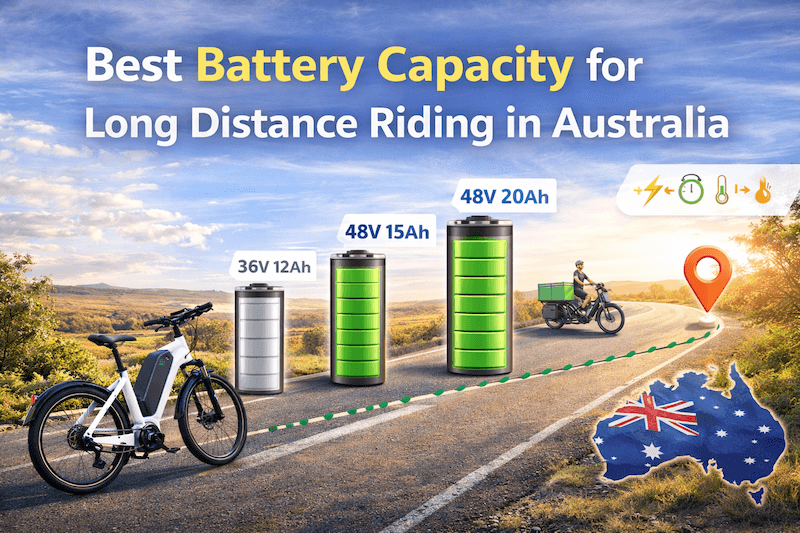
- 48V 10Ah battery = 480Wh
- 48V 15Ah battery = 720Wh
- 48V 20Ah battery = 960Wh
The higher the watt-hour rating, the longer the potential riding distance.
Typical E-Bike Battery Capacities
Most electric bikes use lithium battery packs with capacities between 10Ah and 20Ah.
Below are common options used by e-bike manufacturers.
36V 10Ah – 12Ah
Typical range:
40–60 km (25–37 miles)
Suitable for:
- Short urban commuting
- Lightweight e-bikes
- Budget-friendly models
However, these batteries may not provide sufficient range for many Australian riders.
48V 13Ah – 15Ah
Typical range:
60–90 km (37–55 miles)
This configuration is becoming one of the most common setups for commuter e-bikes.
Advantages include:
- Balanced performance
- Improved acceleration
- Adequate range for daily commuting
Many e-bike brands targeting Australian cities prefer this battery size.
48V 17Ah – 20Ah+
Typical range:
90–140 km (55–87 miles)
These larger batteries are ideal for:
- Long-distance riders
- Electric cargo bikes
- Delivery fleets
- Outdoor recreational riding
Higher-capacity batteries are increasingly popular in Australia due to the country’s longer travel distances.
Factors That Influence Real Riding Range
While battery capacity plays a major role, several other factors also affect e-bike range.
These include:
Rider weight
Heavier loads require more power.
Terrain
Hills and uneven terrain consume more energy.
Riding speed
Higher speeds drain the battery faster.
Motor power
More powerful motors typically require larger batteries.
Pedal assistance level
Higher assistance levels increase battery consumption.
For businesses designing e-bikes, optimizing these factors helps improve real-world performance.
Battery Capacity for Cargo and Delivery E-Bikes
Electric cargo bikes and commercial delivery e-bikes are growing rapidly in Australia.
These bikes typically require larger battery capacities due to:
- Heavy cargo loads
- Long delivery routes
- Frequent stop-and-go riding
Many cargo e-bikes use:
- 48V 20Ah batteries
- Dual battery systems
- High-capacity lithium packs above 1000Wh
These configurations allow riders to complete full work shifts without frequent charging.
Why 48V Systems Are Becoming the Standard
Although 36V systems still exist, many modern e-bikes are shifting toward 48V battery platforms.
Advantages include:
- Higher power output
- Better acceleration
- Improved efficiency
- Compatibility with powerful motors
For long-distance riding, 48V battery systems provide a better balance between performance and range.
This is one reason why they are increasingly preferred in Australia’s e-bike market.
Choosing the Right Battery for the Australian Market
For e-bike brands and distributors entering Australia, selecting the right battery specification is crucial.
Key considerations include:
- Expected riding distance
- Motor power requirements
- Target rider type
- Cargo or commuting applications
- Frame design compatibility
Working with an experienced battery manufacturer can help optimize these specifications and improve product reliability.
Custom battery solutions also allow companies to tailor capacity, voltage, and design to specific product models.
The Growing Demand for High-Capacity E-Bike Batteries
As electric mobility adoption grows across Australia, riders are expecting:
- Longer riding range
- Faster charging
- Reliable battery lifespan
- Strong performance in warm climates
Because of these expectations, high-capacity lithium battery packs are becoming a major competitive advantage for e-bike brands.
Companies that provide long-range battery solutions are better positioned to capture market demand.
High-Capacity Lithium Battery Solutions for E-Bikes
If your company is developing electric bikes for the Australian market, choosing the right battery capacity is essential for long-distance performance.
Battelio provides:
- Custom lithium e-bike battery pack design
- High-capacity battery solutions
- OEM battery manufacturing
- Reliable supply for global e-bike brands
Our battery systems are designed to support long-range riding and real-world mobility applications.
👉 Contact us today to discuss your e-bike battery project.