
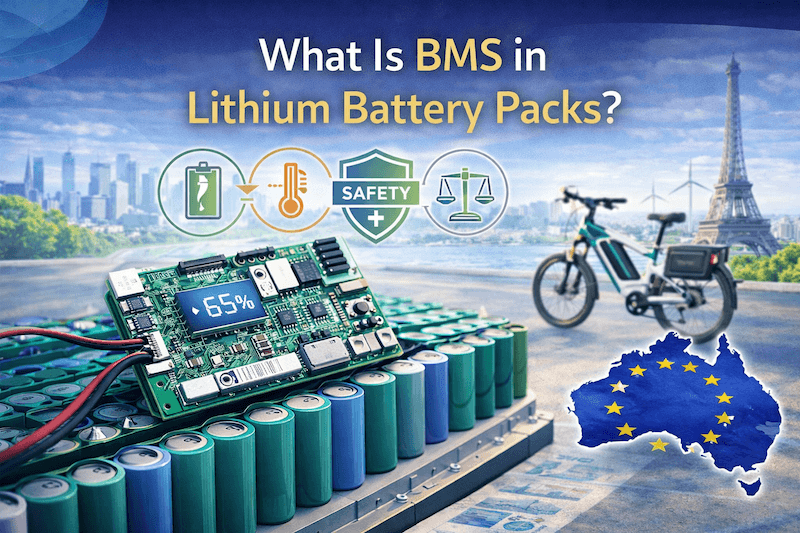
When sourcing lithium battery packs, especially for e-bikes and other electric mobility products, one critical component often mentioned is the BMS. But what exactly is a BMS, and why does it matter for European B2B buyers?
Understanding the role of a Battery Management System (BMS) helps businesses make better purchasing decisions, improve product safety, and ensure long-term reliability.
What Does BMS Stand For?
BMS stands for Battery Management System. It is an electronic system integrated into a lithium battery pack that monitors, protects, and manages the battery’s operation.
A battery pack is not just a group of cells. Without a BMS, even high-quality cells cannot operate safely or consistently. The BMS acts as the “control center” of the battery.
What Does a BMS Do?
A BMS performs several key functions that are essential for safe and stable battery performance.
Monitoring Battery Conditions
The BMS continuously monitors critical parameters such as:
- Voltage (per cell and total pack)
- Current (charging and discharging)
- Temperature
This real-time monitoring ensures the battery operates within safe limits.
Protecting the Battery Pack
One of the most important roles of a BMS is protection. It helps prevent:
- Overcharging
- Over-discharging
- Overcurrent
- Short circuits
- Overheating
Without these protections, a lithium battery pack could become unstable or even unsafe.
Balancing Cells
A battery pack consists of multiple cells connected together. Over time, small differences between cells can lead to imbalance.
The BMS helps balance the cells by ensuring they maintain similar voltage levels. This improves:
- Overall battery efficiency
- Lifespan
- Performance consistency
Controlling Charge and Discharge
The BMS regulates how the battery charges and discharges, ensuring that it operates within designed parameters. This helps maintain battery health and prevents damage from improper usage.
Why BMS Is Critical in E-Bike Battery Packs
For e-bike applications, the BMS plays an essential role in both safety and user experience.
A well-designed BMS helps ensure:
- Stable power output during riding
- Safe charging cycles
- Longer battery lifespan
- Reduced risk of failure in daily use
For European markets, where safety expectations and product reliability standards are high, the quality of the BMS is just as important as the battery cells themselves.
Types of BMS Used in Lithium Battery Packs
Not all BMS systems are the same. Depending on the application and complexity, suppliers may use different types.
Basic BMS
A basic BMS focuses on essential protection functions such as overcharge, over-discharge, and short-circuit protection.
This type is commonly used in standard applications where cost control is important.
Smart BMS
A smart BMS includes advanced features such as:
- Communication interfaces (e.g. Bluetooth, CAN bus)
- Data monitoring and diagnostics
- State of charge (SOC) estimation
- Remote monitoring capabilities
Smart BMS solutions are often used in higher-end e-bike systems or fleet applications where performance tracking and diagnostics are valuable.
How BMS Affects Battery Quality
The BMS directly impacts the overall quality and reliability of a battery pack.
A well-designed BMS can:
- Extend battery lifespan
- Improve safety performance
- Enhance consistency between battery packs
- Reduce after-sales issues
On the other hand, a poorly designed BMS can lead to:
- Frequent battery cut-offs
- Inaccurate capacity readings
- Reduced cycle life
- Increased safety risks
For B2B buyers, evaluating the BMS is an important part of supplier selection.
What European Buyers Should Look for in a BMS
When sourcing lithium battery packs, European businesses should consider several BMS-related factors:
- Reliable protection functions
- Stable performance under different conditions
- Compatibility with the intended application
- Consistent quality across production batches
- Clear technical communication from the supplier
For more advanced applications, buyers may also consider whether a smart BMS is required.
BMS and Compliance Considerations
In Europe, product safety and compliance expectations are high. While the BMS itself is a component, it plays a key role in helping the overall battery pack meet safety and performance requirements.
A properly designed BMS supports:
- Safer product operation
- Better system integration
- Improved reliability during testing and real-world use
Working with a supplier that understands these requirements can reduce risks during product development and market entry.
Choosing a Battery Supplier with Strong BMS Capability
Not all battery suppliers have the same level of expertise when it comes to BMS design and integration.
A reliable supplier should be able to:
- Select appropriate BMS solutions for your application
- Integrate the BMS effectively with the battery pack
- Ensure stable performance across production
- Provide technical support when needed
For European B2B buyers, this capability is essential for building reliable products and maintaining brand reputation.
Work with a Battery Partner That Understands BMS
If your business is sourcing lithium battery packs for e-bikes or other electric mobility products, understanding the role of the BMS is key to making the right decision.
Battelio supports B2B customers with:
- Professionally integrated BMS solutions
- Custom battery pack development
- OEM and wholesale manufacturing
- Reliable support for long-term cooperation
Contact Battelio to learn more about how the right BMS can improve your battery pack performance and reliability.