
When sourcing or designing e-bike battery packs, one of the most important technical decisions is choosing the right battery cell format.
Two of the most widely used lithium-ion cell types are 18650 and 21700.
Both are commonly used in e-bike battery packs, but they differ in size, capacity, performance, and cost.
For e-bike businesses, understanding these differences is not just technical—it directly affects:
- Product performance
- Pricing strategy
- Supply stability
- Customer satisfaction
In this guide, we compare 18650 vs 21700 battery cells from a practical business perspective to help you make the right decision.
What Are 18650 and 21700 Battery Cells?
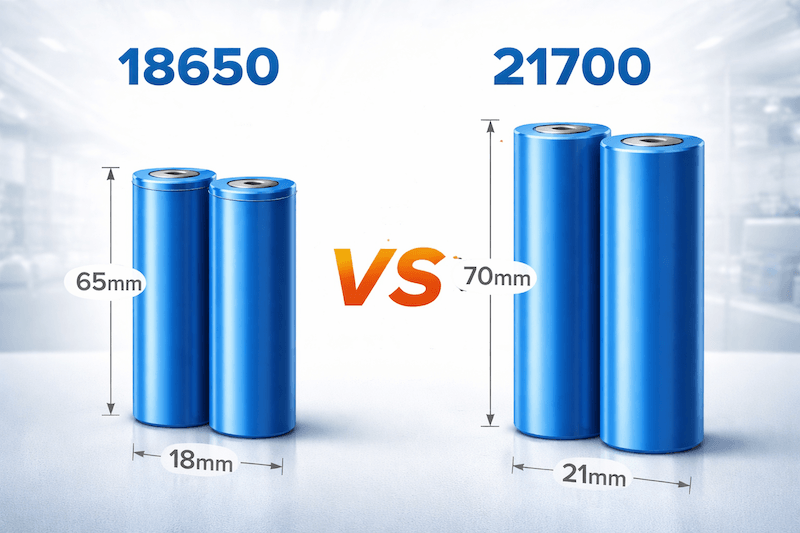
Both 18650 and 21700 are cylindrical lithium-ion battery cells.
Their names refer to their physical dimensions:
18650 Battery Cells
- Diameter: 18 mm
- Length: 65 mm
- Widely used for many years
- Mature and stable supply chain
21700 Battery Cells
- Diameter: 21 mm
- Length: 70 mm
- Newer generation cells
- Increasing adoption in e-bikes and EVs
The larger size of 21700 cells allows for higher energy capacity and improved efficiency.
Key Differences Between 18650 and 21700 Cells
1. Capacity and Energy Density
- 18650 cells: typically 2,500–3,500 mAh
- 21700 cells: typically 4,000–5,000 mAh
👉 21700 cells offer higher capacity, which means:
- Longer riding range
- Fewer cells required per battery pack
2. Performance and Power Output
21700 cells generally provide:
- Better thermal performance
- Higher discharge capability
- Improved efficiency under load
👉 This makes them more suitable for:
- High-power e-bikes
- Cargo e-bikes
- Long-distance applications
3. Battery Pack Design
Because 21700 cells are larger:
- Fewer cells are needed
- Battery pack structure can be simplified
However:
- The pack may require redesigned casing
- Not all systems are compatible with 21700 formats
👉 18650 remains more flexible for standard designs.
4. Cost Considerations
Cost is a key factor for B2B buyers.
- 18650:
- Lower upfront cost
- Widely available
- 21700:
- Higher cost per cell
- Better cost efficiency per Wh over time
👉 For long-term projects, 21700 may offer better value despite higher initial cost.
5. Supply Chain and Availability
- 18650:
- Very mature supply chain
- Multiple suppliers
- Stable pricing
- 21700:
- Growing rapidly
- Increasing adoption globally
👉 Many manufacturers are shifting toward 21700 as the future standard.
18650 vs 21700: Which One Should You Choose?
The right choice depends on your business model and product positioning.
Choose 18650 if you need:
- Lower initial cost
- Compatibility with existing designs
- Proven, widely used technology
- Flexible sourcing options
Choose 21700 if you need:
- Higher energy capacity
- Longer battery range
- Better performance for demanding applications
- Future-oriented product positioning
Business Perspective: What Matters Most?
For e-bike businesses, the decision is not purely technical.
Key factors to consider:
- Target market (entry-level vs premium)
- Product differentiation strategy
- Price sensitivity of customers
- Long-term supply planning
👉 For example:
- Online sellers may prefer 18650 for cost control
- E-bike brands may choose 21700 for performance advantage
The Industry Trend: Transition to 21700
The industry is gradually moving toward 21700 cells.
Reasons include:
- Higher energy efficiency
- Reduced number of cells per pack
- Improved thermal stability
However, 18650 is still widely used and will remain relevant for many applications.
👉 In reality, both formats will coexist for different market segments.
How Cell Choice Affects Battery Pack Quality
Cell selection is one of the most important factors in battery pack performance.
But it is not the only factor.
Other critical elements include:
- BMS (Battery Management System)
- Pack design and structure
- Assembly quality
- Testing and quality control
👉 To better understand this, you may also find this helpful:
What Makes a High-Quality E-Bike Battery Pack?
Conclusion
Both 18650 and 21700 battery cells are reliable options for e-bike battery packs.
- 18650 offers affordability and flexibility
- 21700 provides higher performance and future potential
The best choice depends on your product strategy, cost structure, and target market.
For businesses, working with an experienced supplier ensures you get the right balance between performance, cost, and reliability.
Reliable Lithium Battery Supplier for E-Bike Businesses
Battelio provides:
- Custom lithium battery pack design
- OEM battery manufacturing
- Global supply support