
Choosing the Wrong Battery Can Cost You More Than You Think!
If you’re in the e-bike business—or planning to enter it—you’ve likely faced this question:
Should you choose lithium batteries or lead acid batteries?
At first glance, lead-acid batteries seem attractive:
- Lower upfront cost
- Simple technology
But here’s what many buyers realize too late:
👉 The cheaper option often becomes the more expensive one.
In this guide, we’ll break down the real differences between lithium and lead acid batteries—and help you make the right decision for your business.
What Is a Lead Acid Battery?
Lead-acid batteries are one of the oldest rechargeable battery technologies.
They are commonly used in:
- Traditional scooters
- Backup power systems
- Low-cost electric vehicles
Key characteristics:
- Low upfront cost
- Heavy weight
- Shorter lifespan
What Is a Lithium Battery?
Lithium-ion batteries are the standard for modern e-bikes.
They are widely used because they offer:
- High energy density
- Longer lifespan
- Better efficiency
👉 Today, nearly all high-quality e-bikes use lithium batteries.
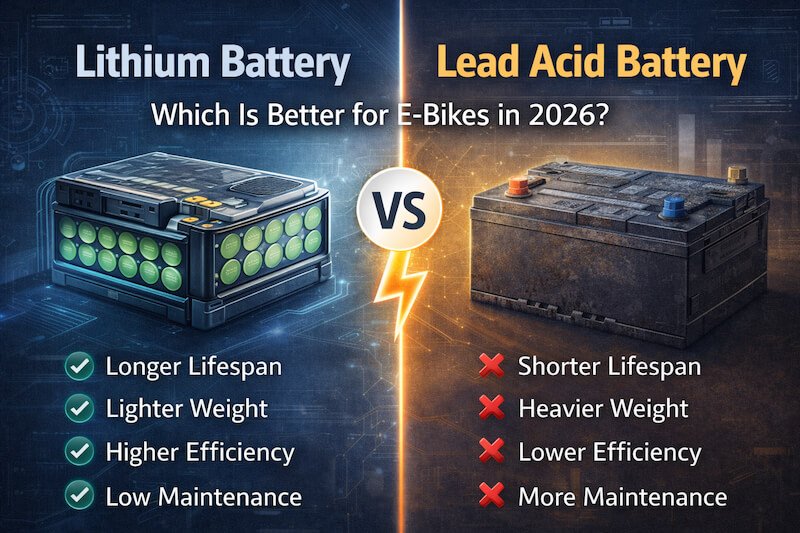
Lithium vs Lead Acid: Key Differences That Matter
Let’s compare what really impacts your business.
1. Weight & Size
- Lead Acid: Heavy and bulky
- Lithium: Lightweight and compact
👉 Impact:
Lighter batteries = better riding experience + easier transport
2. Lifespan (Cycle Life)
- Lead Acid: ~300–500 cycles
- Lithium: ~800–1500+ cycles
👉 Impact:
Lithium batteries last significantly longer → fewer replacements
3. Energy Efficiency
- Lead Acid: Lower efficiency
- Lithium: Higher energy output
👉 Impact:
Lithium provides more usable power and a longer range
4. Charging Time
- Lead Acid: Slower charging
- Lithium: Faster charging
👉 Impact:
Faster turnaround = better user experience
5. Maintenance
- Lead Acid: Requires more maintenance
- Lithium: Minimal maintenance
👉 Impact:
Less hassle for both users and businesses
6. Total Cost (This Is Where It Gets Interesting)
At first:
- Lead Acid = cheaper
- Lithium = more expensive
But over time:
👉 Lead Acid:
- More replacements
- Higher maintenance
- More returns
👉 Lithium:
- Longer life
- Fewer issues
- Better performance
👉 Result:
Lithium batteries often have a lower total cost of ownership.
Real Insight: Why the Market Is Moving to Lithium
Here’s what’s happening globally:
👉 Most e-bike brands are shifting to lithium.
Why?
Because:
- Customers demand better performance
- Return rates are lower
- Brand reputation depends on reliability
👉 Lead acid is gradually being phased out in quality-focused markets.
When Does Lead Acid Still Make Sense?
To be fair, lead-acid batteries still have limited use cases:
- Extremely price-sensitive markets
- Low-end or short-distance applications
But even in these cases:
👉 The trade-offs are significant.
Common Mistake: Choosing Based Only on Price
This is one of the biggest mistakes buyers make.
👉 They compare only:
- Unit price
But ignore:
- Replacement cost
- Warranty issues
- Customer complaints
👉 In reality:
The cheapest battery often leads to the highest long-term cost.
Final Verdict: Which One Should You Choose?
If your goal is:
- Better product quality
- Lower return rate
- Higher customer satisfaction
- Stronger brand positioning
👉 Lithium battery is the clear winner
Looking for a Reliable Lithium Battery Solution?
If you’re planning to upgrade from lead-acid to lithium—or want to improve your current battery quality—we can help.
At Battelio, we specialize in:
- High-performance lithium battery packs
- Custom solutions for e-bike brands
- Reliable quality for global markets
👉 Contact us today to explore the right solution for your business.