
One of the most common questions e‑bike riders and brands ask is:
“How far will my battery take me?”
The answer isn’t magic – it’s math. And once you understand the simple relationship between watt‑hours (Wh) and range, you can design better products, set realistic customer expectations, and reduce warranty confusion.
In this guide, we’ll show you exactly how to calculate e‑bike battery range from Wh to kilometers, what factors affect real‑world range, and how Battelio helps you build batteries that deliver consistent, predictable performance.
The Basic Formula: Wh → KM
The core formula is surprisingly simple:
Estimated Range (km) = (Battery Energy (Wh) × Efficiency Factor) ÷ Energy Consumption (Wh/km)
But let’s break it down step by step.
Step 1 – Know your battery’s usable energy (Wh)
Most e‑bike batteries are rated in watt‑hours (Wh).
If you only see voltage (V) and amp‑hours (Ah), calculate: Wh = V × Ah
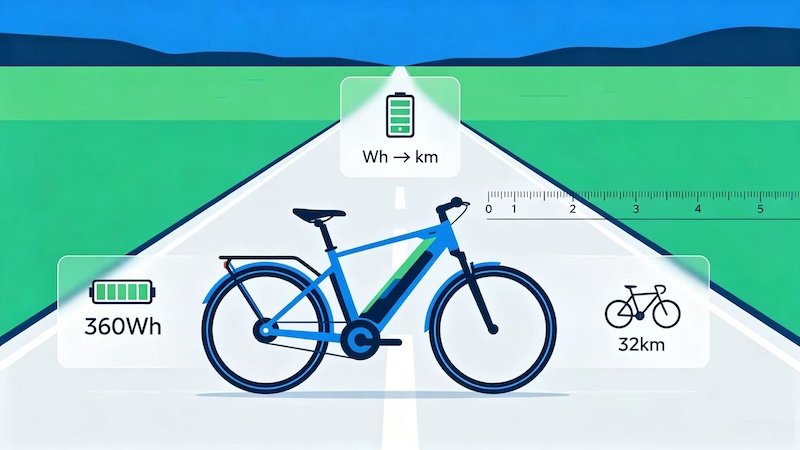
Example: A 36V 10Ah battery → 36 × 10 = 360 Wh
Note: Usable energy is slightly less due to BMS low‑voltage cut‑off. For lithium‑ion, we usually use 90–95% of rated Wh. But for initial estimation, rated Wh is fine.
Step 2 – Estimate energy consumption (Wh/km)
This is the energy your motor uses to move the bike. Typical values for e‑bikes:
| Riding condition | Energy consumption |
|---|---|
| Flat, low assist, light rider | 6–8 Wh/km |
| Mixed terrain, medium assist | 9–12 Wh/km |
| Hilly, high assist, heavy load | 13–18 Wh/km |
| Throttle only, no pedaling | 15–20 Wh/km |
Example: A commuter on flat roads with medium assist → 10 Wh/km
Step 3 – Apply efficiency factor
No system is 100% efficient. Motor, controller, drivetrain, and battery internal resistance cause losses. A realistic efficiency factor is 0.85–0.95.
Example: Using 0.9 (90% efficiency)
Step 4 – Calculate range
Range (km) = (Battery Wh × Efficiency) ÷ Consumption (Wh/km)
Example: 360 Wh battery, 10 Wh/km consumption, 0.9 efficiency
→ (360 × 0.9) ÷ 10 = 32.4 km
That’s the estimated range under those conditions.
Real Example: Two Batteries Compared
| Battery | Voltage | Capacity | Wh | Consumption | Efficiency | Estimated range |
|---|---|---|---|---|---|---|
| Small | 36V | 10Ah | 360 | 10 Wh/km | 0.9 | 32 km |
| Large | 48V | 14Ah | 672 | 10 Wh/km | 0.9 | 60 km |
Larger battery = more than double the range (because Wh increased by 86%).
6 Factors That Change Real‑World Range (Drastically)
The formula is a starting point. Real range depends heavily on these:
1. Rider weight + cargo
Every extra 10kg adds ~5–8% energy consumption.
2. Tire pressure and type
Low pressure or knobby tires increase rolling resistance → reduce range by 10–20%.
3. Terrain
Hills demand high torque. Climbing a 5% grade doubles energy use per km.
4. Assist level/ throttle
Turbo mode uses 2–3x more energy than Eco mode.
5. Wind and temperature
Headwind acts like an uphill. Cold (below 10°C) temporarily reduces lithium battery capacity by 15–25%.
6. Battery age
After 500 cycles, a quality lithium battery still holds ~80% of its original range. Cheap batteries degrade faster.
Battelio batteries using Samsung/LG/Panasonic cells retain consistent range for over 1,500 cycles – so your range calculation stays reliable for years.
Quick Reference Table: Wh to KM (for typical e‑bike)
Assuming 10 Wh/km consumption (mixed use, medium assist):
| Battery energy (Wh) | Estimated range (km) | Best for |
|---|---|---|
| 300 Wh | 25–30 km | Short commutes, city bikes |
| 400 Wh | 35–40 km | Daily commuter (10‑15 km one way) |
| 500 Wh | 45–50 km | Leisure, longer commutes |
| 625 Wh | 55–65 km | Hilly areas, cargo bikes |
| 750 Wh | 65–75 km | Heavy use, delivery fleets |
| 1,000 Wh | 85–100 km | Long distance, touring |
Note: Using higher assist or hills will reduce these numbers by 20–40%.
How to Communicate Range to Your Customers – Without Overpromising?
Many e‑bike brands get warranty returns because they claim a single “max range” number that’s only achievable on flat ground, no wind, lowest assist.
Better approach: Give a range window.
Example for a 500 Wh battery:
“Under typical mixed conditions, expect 40–60 km. Light assist on flat roads can reach 70 km. Heavy hills or high speed reduce to 30–35 km.”
Customers appreciate honesty. And when their real range matches your estimate, they trust your brand.
How Battelio Helps You Deliver A Consistent Range?
🔋 Premium cells (Samsung, LG, Panasonic)
A flatter discharge curve means voltage doesn’t drop sharply – range prediction stays accurate.
🧠 Smart BMS
Our BMS (top‑5 brand) protects against over‑discharge and balances cells, so the range doesn’t degrade quickly after months of use.
📊 Custom engineering support
We can simulate your bike’s expected range using motor power, controller settings, and typical terrain – before you mass produce.
🔁 Sample testing
We provide real samples. You can mount the battery on your bike, ride it, and measure the actual range. No guessing.
📄 Clear labelling
We print Wh, V, Ah clearly on every pack – so your customers can also calculate range themselves.
FAQ – Range Calculation Questions
Q: Does a higher voltage battery give more range?
Not directly. Higher voltage can reduce current draw, which may improve efficiency slightly. But Battery Energy (Wh) is the real measure. A 48V 10Ah (480Wh) has less range than a 36V 15Ah (540Wh), all else equal.
Q: Can I extend the range by changing the controller?
Yes – a controller with more efficient algorithms can add 5–10% range. But never exceed battery or motor ratings.
Q: My customer says, “My range dropped 50% after 3 months”. What happened?
Likely a defective cell group or BMS issue – or the customer always rides in Turbo uphill. For quality batteries, the range drop should be <10% after 1 year of normal use.
Q: How do I calculate the range for a two‑battery system (dual batteries)?
Simply add the Wh. Example: 500Wh + 500Wh = 1000Wh total usable. Then use the same formula.
The Bottom Line
Calculating e‑bike range is not a mystery. You just need:
- Accurate battery Wh
- Realistic Wh/km consumption for your use case
- A small efficiency factor
- Honesty about terrain and assist level
Share this knowledge with your customers. They will appreciate the transparency – and trust your brand more.
And when you need batteries that deliver consistent, reliable range ride after ride, year after year – Battelio is ready to help.
Need a Battery That Matches Your Range Promise?
Whether you’re designing a commuter e‑bike, a cargo bike, or a delivery fleet, we can build a custom lithium battery that meets your target range.
📧 Contact Battelio today – tell us your desired range, motor power, and typical riding conditions. We’ll reply within 24 hours with:
- Recommended Wh and voltage
- Estimated real‑world range for your bike
- Sample availability and pricing
👉 Stop guessing. Start calculating. Build a better e‑bike with Battelio.
Battelio – Since 2018, trusted by e‑bike brands across Europe, North America, and Australia for reliable, long‑range lithium battery solutions.