
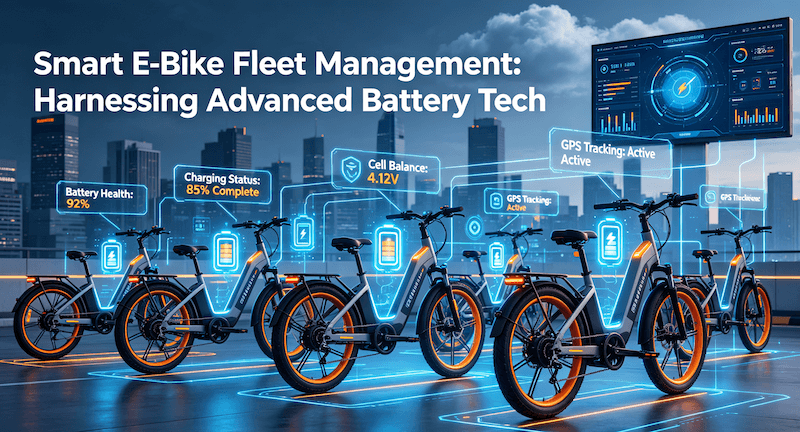
Managing an e-bike fleet is expensive when battery failures, downtime, and maintenance issues pile up. Many operators still rely on basic battery systems with limited visibility. A smart BMS solves this by giving fleet managers real-time battery monitoring, predictive maintenance insights, and improved operational control.
A smart BMS (Battery Management System) for e-bike fleets is an intelligent battery control platform that monitors battery health, temperature, charging cycles, cell balance, and fleet-wide performance in real time. It helps e-bike companies reduce battery failures, improve safety, extend battery lifespan, lower maintenance costs, and optimize fleet operations through data analytics, GPS tracking, and remote diagnostics.
As commercial e-bike fleets grow, battery intelligence becomes a competitive advantage rather than just a technical feature.
What Is a Smart BMS for E-Bike Fleets?
A smart BMS is the electronic system that manages and protects lithium-ion batteries used in e-bikes. Unlike traditional battery protection boards, smart BMS platforms collect and analyze battery data continuously.
For commercial fleets, this matters a lot.
Fleet operators need visibility into:
- Battery health
- Charging cycles
- Temperature behavior
- Cell balancing
- Energy consumption
- Vehicle uptime
Without intelligent monitoring, battery failures can happen unexpectedly and create operational disruptions.
Modern smart BMS systems can also connect with cloud software, mobile apps, GPS modules, and fleet management dashboards.
[Placeholder Resource Link: Global Lithium Battery Safety Standards]
What Is the Difference Between Hardware BMS and Smart BMS?
Traditional hardware BMS systems mainly focus on basic battery protection. They help prevent:
- Overcharging
- Over-discharging
- Overcurrent events
- Short circuits
However, they provide very limited operational data.
A smart BMS adds communication and analytics capabilities. This gives fleet operators access to real-time battery insights and remote diagnostics.
Key differences include:
| Hardware BMS | Smart BMS |
|---|---|
| Basic protection only | Real-time monitoring |
| No cloud connectivity | Cloud and IoT integration |
| Limited diagnostics | Predictive analytics |
| Manual inspections required | Remote monitoring |
| Minimal scalability | Fleet-wide management |
Many fleet buyers now prioritize smart BMS systems because they improve scalability and operational efficiency.
Bluetooth, CAN bus, RS485, and GPS integration are now common requirements in the best smart BMS for e bike fleets.
Why Are Smart BMS Systems Important for Commercial E-Bike Fleets?
Battery systems are one of the most expensive parts of any commercial e-bike operation.
For delivery companies, rental fleets, and mobility providers, battery downtime directly affects revenue.
A smart BMS helps solve several major business problems:
- Unexpected battery failures
- High replacement costs
- Safety incidents
- Inconsistent charging practices
- Fleet downtime
- Maintenance inefficiencies
For example, if a fleet manager operates 500 e-bikes, manually checking every battery pack becomes unrealistic. Smart BMS software automates monitoring and alerts.
This improves:
- Fleet uptime
- Operational reliability
- Maintenance scheduling
- Asset utilization
Companies using smart battery systems can often extend battery lifespan significantly through optimized charging and balancing.
How Smart BMS Technology Improves Battery Safety
Safety is one of the biggest reasons commercial buyers invest in smart BMS systems.
Lithium-ion batteries can become dangerous if:
- Cells overheat
- Charging becomes unstable
- Voltage imbalance occurs
- Physical damage goes undetected
A smart BMS continuously monitors battery conditions and reacts instantly when abnormalities appear.
Core safety features include:
- Thermal protection
- Cell balancing
- Overcharge prevention
- Over-discharge protection
- Current limitation
- Fault isolation
- Short-circuit detection
Some advanced systems can even shut down charging remotely if unsafe conditions are detected.
This is especially important for:
- Shared mobility fleets
- Urban delivery fleets
- Warehouse charging stations
- High-cycle fleet operations
[Placeholder Resource Link: Lithium-Ion Battery Fire Prevention Research]
Real-Time Monitoring and Remote Diagnostics
One of the biggest advantages of a smart BMS is remote visibility.
Fleet operators can monitor battery conditions through centralized dashboards without physically inspecting every bike.
Typical smart BMS dashboards display:
- State of charge (SOC)
- State of health (SOH)
- Temperature data
- Cell voltage
- Charging status
- Fault notifications
- GPS location
This allows maintenance teams to identify battery problems before failures occur.
Remote diagnostics also reduce labor costs because technicians can troubleshoot many issues without removing battery packs.
Some platforms even support:
- OTA firmware updates
- Predictive maintenance alerts
- Battery lifecycle analytics
- Usage trend reporting
These capabilities are becoming increasingly valuable in large electric bike marketplace operations.
What Are the Three Types of BMS?
Commercial buyers should understand the three common BMS architectures before choosing a solution.
1. Single-Board BMS
This is the simplest design. All monitoring and protection functions exist on one board.
Best for:
- Small fleets
- Budget applications
- Lower-power systems
2. Distributed BMS
Each battery module contains its own monitoring electronics.
Best for:
- Modular battery systems
- Swappable battery platforms
- Scalable fleets
3. Centralized BMS
A central controller manages multiple battery modules simultaneously.
Best for:
- Large commercial fleets
- Enterprise mobility systems
- Advanced analytics platforms
For most large e-bike companies, centralized or distributed smart BMS systems provide the best scalability and operational visibility.
How Smart BMS Reduces Fleet Operating Costs
Battery replacement costs can severely impact fleet profitability.
A smart BMS helps reduce costs in several ways.
Extending Battery Lifespan
Smart charging algorithms reduce battery stress and improve long-term durability.
Reducing Manual Inspections
Automated monitoring lowers labor requirements.
Minimizing Downtime
Predictive maintenance identifies issues before failures happen.
Improving Charging Efficiency
Smart charging optimization reduces wasted energy and charging errors.
Preventing Premature Battery Replacement
Battery health analytics help operators make data-driven replacement decisions.
For large operators, even a small increase in battery lifespan can create major savings across hundreds or thousands of vehicles.
This is why many fleet buyers researching e-bike battery BMS replacement projects are now upgrading directly to intelligent systems.
Key Features to Look for in the Best Smart BMS for E-Bike Fleets
Not all smart BMS platforms are built for commercial use.
Fleet buyers should evaluate several critical features before selecting a system.
Communication Support
Look for:
- CAN bus
- Bluetooth
- RS485
- UART connectivity
GPS Integration
Useful for:
- Anti-theft protection
- Fleet tracking
- Asset monitoring
Data Logging
Historical battery data support predictive maintenance and warranty analysis.
OTA Firmware Updates
Remote software updates simplify fleet management.
API Integration
Integration with fleet software platforms improves operational efficiency.
Scalability
The platform should support future fleet growth.
Smart Charging Support
Advanced charging logic helps maximize battery health and reduce degradation.
Companies comparing the best smart BMS for e-bike fleets often prioritize software capabilities just as much as hardware quality.
Smart BMS and Predictive Maintenance
Predictive maintenance is becoming a major trend in fleet electrification.
Instead of waiting for failures, smart BMS systems identify early warning signs.
Examples include:
- Abnormal temperature patterns
- Rapid voltage drops
- Cell imbalance
- Charging irregularities
- Excessive cycle degradation
This allows maintenance teams to replace or repair batteries proactively.
Predictive maintenance can reduce:
- Emergency repairs
- Vehicle downtime
- Warranty claims
- Operational disruptions
As AI analytics improve, smart BMS platforms are becoming more accurate at forecasting battery performance and remaining lifespan.
Integration with Fleet Management Platforms
Modern e-bike fleets rely heavily on software ecosystems.
A smart BMS should integrate smoothly with:
- Fleet telematics systems
- Delivery management software
- Rental platform dashboards
- IoT infrastructure
- Smart charging networks
Integration creates a unified operational view for fleet managers.
For example, operators can combine:
- GPS data
- Battery health data
- Rider behavior
- Maintenance history
This helps improve:
- Route planning
- Energy optimization
- Asset allocation
- Service scheduling
Some systems also integrate with e-bike battery store networks and service partners for faster replacement logistics.
Challenges When Upgrading an Existing E-Bike Fleet
Upgrading older fleets to smart BMS technology can involve several challenges.
Compatibility Issues
Legacy battery packs may not support advanced communication protocols.
Hardware Limitations
Older motors and controllers may require upgrades.
Deployment Costs
Initial installation costs can be significant for large fleets.
Training Requirements
Maintenance teams may need technical training on new systems.
However, many operators still move forward because long-term savings often outweigh upfront investment costs.
Some companies also combine smart BMS upgrades with:
- eBike motor upgrade projects
- Battery rebuild programs
- Fleet electrification initiatives
Future Trends in Smart BMS for E-Bikes
The future of smart battery management is moving quickly.
Several technologies are expected to shape next-generation e-bike fleets.
AI-Powered Battery Optimization
Machine learning can improve charging strategies and predict failures more accurately.
Swappable Battery Ecosystems
Smart BMS systems will help coordinate battery swapping infrastructure.
Faster Smart Charging
Advanced charging control will reduce charging times while protecting battery health.
Sustainable Battery Lifecycle Management
Battery analytics will support recycling and second-life battery applications.
Full IoT Integration
Future smart BMS systems will become part of larger connected mobility ecosystems.
As urban transportation evolves, intelligent battery management will become a core requirement rather than an optional upgrade.
Summary
Smart BMS technology is rapidly becoming a core infrastructure component for commercial e-bike fleets. Companies that invest in intelligent battery management gain better safety, longer battery lifespan, lower operating costs, and stronger fleet reliability in an increasingly competitive mobility market.