
Why Understanding Battery Technology Matters?
If you’re in the e-bike business, you’ve probably heard terms like:
- Lithium-ion
- BMS
- Energy density
- Cycle life
But here’s the reality:
👉 Most people use e-bike batteries — very few actually understand them.
And that lack of understanding often leads to:
- Choosing the wrong supplier
- Higher return rates
- Customer complaints
- Shorter product lifespan
So in this guide, we’ll break down lithium battery technology for electric bikes in a simple, practical way — so you can make smarter decisions for your business.
What Is a Lithium Battery (And Why It Dominates E-Bikes)
A lithium battery is the core power source of modern e-bikes.
Compared to older technologies (like lead-acid batteries), lithium batteries offer:
- Higher energy density (more power, less weight)
- Longer lifespan
- Faster charging
- Better efficiency
👉 That’s why nearly all modern e-bikes rely on lithium-ion technology.
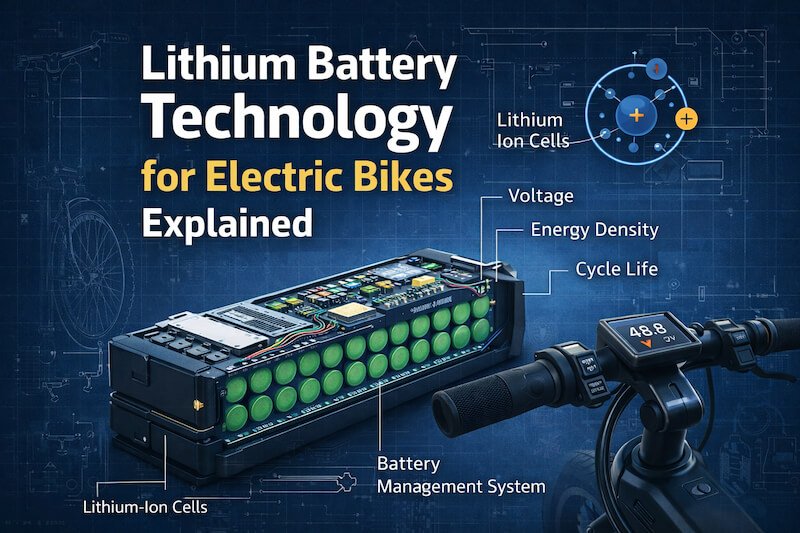
Key Components Inside an E-Bike Battery
To understand performance, you need to understand structure.
An e-bike battery pack is made of 3 main parts:
1. Battery Cells (The Heart of the System)
Battery cells store and release energy.
Common formats:
- 18650 cells
- 21700 cells
Quality matters a lot here.
👉 High-quality cells =
- Stable performance
- Longer lifespan
- Lower failure rate
2. Battery Management System (BMS)
The BMS is like the “brain” of the battery.
It controls:
- Charging and discharging
- Temperature protection
- Cell balancing
👉 A weak BMS is one of the top reasons for battery failure
3. Battery Pack Structure
This includes:
- Housing (case design)
- Wiring and connectors
- Thermal management
👉 Good design improves:
- Safety
- Durability
- Heat dissipation
How Lithium Batteries Actually Work (Simple Explanation)
At a basic level:
👉 Lithium ions move between two electrodes:
- Anode
- Cathode
During:
- Charging → energy is stored
- Discharging → energy is released
👉 This movement creates electricity to power the motor.
You don’t need to be an engineer to understand this — but knowing the basics helps you evaluate quality.
5 Key Performance Factors You Should Care About
Now let’s move from “what it is” to “what matters for your business”.
1. Capacity (Ah)
This determines how much energy the battery can store.
👉 Higher capacity = longer riding range
2. Voltage (V)
This affects power output.
Common e-bike options:
- 36V
- 48V
- 52V
👉 Higher voltage = stronger performance
3. Cycle Life
This is how many times a battery can be charged and discharged.
👉 Longer cycle life = lower replacement cost
4. Energy Density
This tells you how much energy is stored per weight.
👉 Higher density = lighter battery + better efficiency
5. Safety & Stability
This depends on:
- Cell quality
- BMS design
- Manufacturing process
👉 This directly impacts:
- Return rate
- Customer satisfaction
Why Battery Quality Varies So Much in the Market
Here’s something many buyers don’t realize:
👉 Two batteries can look identical — but perform completely differently.
Why?
Because of differences in:
- Cell grade (Grade A vs mixed cells)
- BMS quality
- Testing standards
- Manufacturing consistency
👉 This is where most problems start.
Common Mistakes Buyers Make (And How to Avoid Them)
❌ Choosing Based on Price Only
Cheap batteries often mean:
- Lower-grade cells
- Weak testing
- Higher failure rates
❌ Ignoring Testing Data
If a supplier cannot provide:
- Cycle test data
- Aging test results
👉 That’s a red flag
❌ Overlooking BMS Quality
Many buyers focus only on cells.
👉 But BMS failure = battery failure
Technology Alone Is Not Enough
Here’s the truth:
👉 Good battery performance is not just about technology — it’s about execution.
That includes:
- Quality control
- Engineering experience
- Manufacturing process
Understanding Leads to Better Decisions
You don’t need to become a battery engineer.
But understanding lithium battery technology helps you:
- Choose better suppliers
- Reduce product issues
- Improve customer satisfaction
- Protect your brand
👉 And in the long run, that means higher profits and fewer headaches.
Need a Reliable Battery Solution?
If you’re sourcing e-bike batteries and want a partner who truly understands both technology and real-world application, we can help.
At Battelio, we focus on:
- High-quality lithium battery packs
- Reliable performance
- Custom solutions for e-bike brands
👉 Contact us today to discuss your project.