
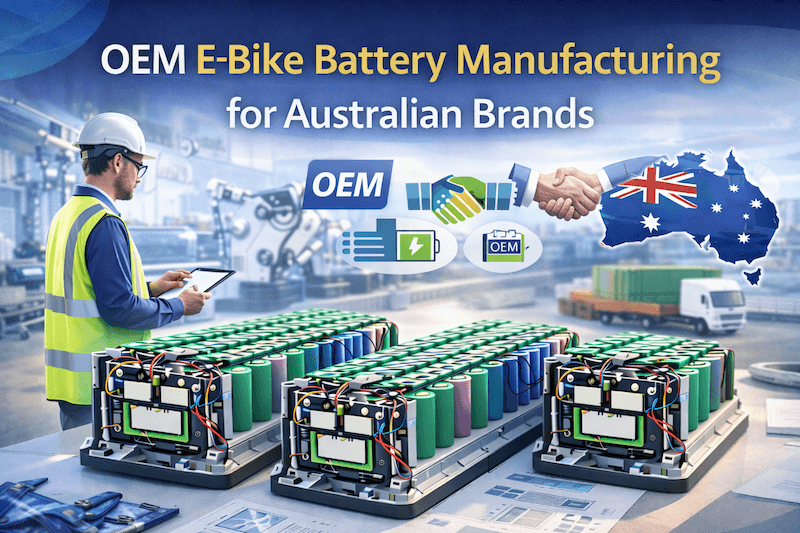
Australia’s electric bike industry is expanding rapidly as more consumers adopt electric mobility for commuting, recreation, and delivery services. As the market grows, many Australian e-bike brands are seeking reliable OEM battery manufacturers to support product development and large-scale production.
For brands entering or expanding within the Australian e-bike market, partnering with an experienced OEM lithium battery manufacturer can significantly improve product performance, reliability, and supply stability.
This guide explains how OEM e-bike battery manufacturing works and why it is an important strategy for Australian brands.
The Growing Demand for E-Bike Batteries in Australia
Electric bike adoption in Australia has increased steadily over the past few years. Urban commuters, delivery riders, and outdoor enthusiasts are increasingly choosing e-bikes as a convenient and eco-friendly transportation option.
Several factors are driving this demand:
- Rising fuel prices and transportation costs
- Expansion of cycling infrastructure in major cities
- Increased interest in sustainable mobility solutions
- Growth of delivery services using electric bikes
As e-bike demand grows, Australian brands must ensure they have reliable battery suppliers capable of supporting consistent product quality and large production volumes.
What Is OEM E-Bike Battery Manufacturing?
OEM (Original Equipment Manufacturer) battery manufacturing refers to the process where a specialized manufacturer produces battery packs for another brand’s electric bike products.
Instead of producing batteries internally, e-bike brands partner with experienced battery manufacturers who provide:
- Custom battery pack design
- Engineering support
- Large-scale production
- Quality testing and certification
This allows brands to focus on product design, marketing, and sales while relying on battery experts to handle production.
Advantages of OEM Battery Manufacturing for Australian Brands
Working with an OEM lithium battery manufacturer offers several advantages for companies operating in the Australian e-bike market.
Product Customization
Every electric bike model may require a different battery configuration. OEM manufacturers can design battery packs tailored to specific requirements such as:
- Battery voltage (36V, 48V, or higher)
- Battery capacity
- Frame integration
- Mounting systems and connectors
Custom battery packs help brands optimize performance and improve the overall design of their e-bikes.
Professional Battery Engineering
Lithium battery pack design requires specialized knowledge in areas such as cell selection, thermal management, and battery protection systems.
Experienced OEM manufacturers typically provide:
- Battery Management System (BMS) integration
- Cell matching and balancing
- Thermal protection design
- Safety testing procedures
This expertise helps ensure reliable battery performance and product safety.
Scalable Manufacturing Capacity
As e-bike brands grow, demand for battery packs may increase rapidly.
OEM manufacturers typically operate advanced production lines capable of producing battery packs at scale while maintaining consistent quality.
This enables brands to scale production efficiently without investing heavily in their own battery manufacturing facilities.
Quality Control and Testing
Battery safety and reliability are critical for electric mobility products.
Professional OEM battery manufacturers implement strict quality control procedures, including:
- Cell grading and matching
- Automated welding processes
- Battery pack performance testing
- Aging and reliability tests
These processes help ensure every battery pack meets consistent safety and performance standards.
Key Battery Specifications for Australian E-Bikes
When developing electric bikes for the Australian market, brands typically focus on several important battery specifications.
Battery Voltage
Common voltage systems include:
- 36V batteries for standard commuter e-bikes
- 48V batteries for higher power and improved acceleration
Many modern e-bike models in Australia are transitioning toward 48V battery systems for enhanced riding performance.
Battery Capacity
Battery capacity determines the riding range of an electric bike.
Typical capacities include:
- 10Ah – 12Ah for short-distance commuting
- 13Ah – 15Ah for standard urban use
- 17Ah – 20Ah+ for long-distance riding or cargo e-bikes
Australian riders often travel longer distances, so higher capacity batteries are increasingly popular.
Safety and Protection Systems
Modern lithium battery packs include advanced safety features such as:
- Battery Management Systems (BMS)
- Overcharge protection
- Short circuit protection
- Temperature monitoring
These systems help ensure safe and stable operation under different riding conditions.
Choosing the Right OEM Battery Manufacturer
Selecting the right OEM battery partner is one of the most important decisions for e-bike brands.
Key factors to consider include:
- Manufacturing experience in lithium battery packs
- Quality control and testing procedures
- Ability to design custom battery solutions
- Compliance with international safety standards
- Reliable production capacity and supply chain
Working with an experienced battery manufacturer allows brands to bring high-quality products to market more efficiently.
Supporting Australian E-Bike Brands with Custom Battery Solutions
As the Australian e-bike market becomes more competitive, product differentiation is increasingly important.
Custom OEM battery packs allow brands to:
- Improve bike frame integration
- Increase riding range
- Optimize power performance
- Create unique product designs
These advantages help e-bike brands stand out in a growing market.
OEM Lithium Battery Manufacturing for E-Bike Brands
If you are developing electric bikes for the Australian market, choosing the right OEM battery partner is essential.
Battelio provides:
- Custom lithium e-bike battery pack design
- OEM battery manufacturing services
- Reliable global supply for e-bike brands
- Professional engineering and technical support
👉 Contact us today to discuss your OEM e-bike battery manufacturing needs.